A Brazilian innovation that transforms waste into durable and environmentally friendly infrastructure.
Amid the environmental challenges of the 21st century, the reuse of materials has become not only a necessity, but an ethical and economic imperative. One of the most promising examples comes from the infrastructure sector: Ecological asphalt, produced with used tire rubber.
More than a technological innovation, this practice represents a true paradigm shift. On one hand, it combats the improper disposal of waste; on the other, it offers a more resistant, quieter, and more durable pavement. And the best part: it's already a reality on several Brazilian highways.
The weight of the problem: where do used tires end up?
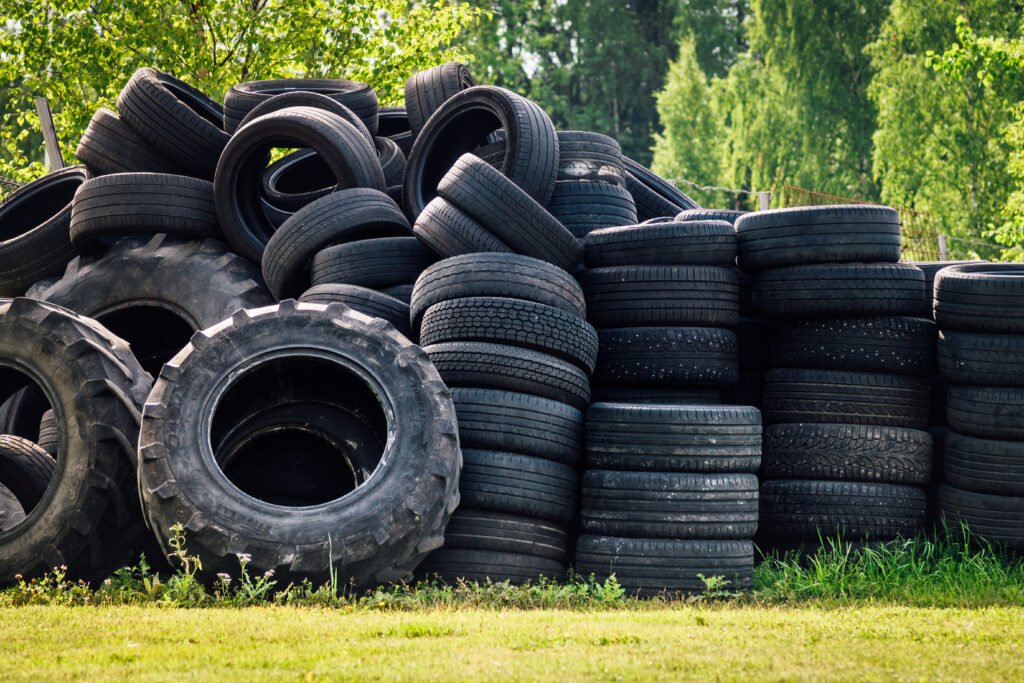
In Brazil, approximately 450,000 tons of tires Every year, 90 million cigarettes are discarded. When disposed of improperly, they become environmental villains: they take centuries to decompose, can contaminate the soil, and turn into breeding grounds for dengue mosquitoes.
A large stack of used up vehicle tires, stapled in rows
This situation has worsened in recent decades with the growth of the national fleet. More cars, more tires, more waste. And an inevitable question: how to give this waste a smart destination?
The answer lies in the asphalt.
It was from engineering that an ingenious solution emerged: incorporating the rubber from unusable tires into the asphalt mix. The result is what is called... asphalt-rubber, or Ecological asphalt — a mixture that may contain up to 20% of rubber powder in its formulation.
In addition to solving the waste disposal problem, the new asphalt offers significant improvements. It features longer lifespan up to 33% than conventional, larger adhesion, best performance in extreme climates and even a reduction of noise caused by traffic.
Sustainable and functional — but still with challenges.
Like all innovations, eco-friendly asphalt is not without its obstacles. Its initial cost can be up to... 50% larger than traditional asphalt, due to the additional production processes. There are also technical challenges, such as standardizing the rubber and making adjustments to the plants and application techniques.
However, the equation changes when one evaluates the total life cycle cost of the pavement. The durability of eco-friendly asphalt requires less maintenance and repairs — which means savings in the medium and long term.
Where innovation is already underway.
Several Brazilian states have already adopted this technology. In São Paulo, the highways... Immigrants and Anchieta The roads were resurfaced with the new asphalt, thanks to the work of Ecovias, which has its own plant for producing the ecological mixture. One kilometer of pavement can reuse up to 600 tires.
In Rio de Janeiro, the highway RJ-122, between Cachoeiras de Macacu and Guapimirim, used 420,000 recycled tires within a stretch of just 35 km. Dealerships like... CCR They adopted rubberized asphalt on approximately 15% of the roads they manage, such as CCR AutoBan and CCR NovaDutra.
Far beyond the pavement
More than just a paving technology, eco-friendly asphalt represents a cultural change: a concrete way to unite development and preservation. He also highlights the role of partnerships between the public sector, the private sector, and civil society.
One example is Reciclanip, Created in 2007 by the National Association of the Tire Industry, this organization coordinates the collection and disposal of unusable tires in Brazil and is now a benchmark in reverse logistics and the circular economy.
The future is recycled rubber.
Given the data, the path forward seems clear: investing in sustainable solutions like eco-friendly asphalt is not only viable, but urgent. It's a smart way to transform a problematic waste in quality infrastructure, helping to preserve the environment without sacrificing progress.
In a country where roads are the main link in the economy, adopting technologies like this could mean... Less waste, more safety, and greater efficiency.. Ultimately, sustainability also begins with the ground we walk on — or the road we drive on.
Brazilian roads accumulate functions that their original design did not foresee. Redistributing the road section and taking care of the pedestrian scale…
It is crucial to remember that the concept of "environment" extends beyond the physical-natural dimension to encompass the social world. The strategies…