Innovation and sustainability: the path to a greener future.
December 10, 2023
By Victoria Rodrigues
CasesEnvironmentSocialSolutionsTendencies
Amidst growing demands for solutions that combine urban development and environmental preservation, the construction sector has emerged as a fertile ground for sustainable innovations. Eco-friendly materials, regenerative technologies, and intelligent public policies are shaping a new paradigm where building and coexisting with the environment are no longer opposing actions, but complementary ones. In this scenario, two areas stand out: advances in sustainable building materials and efficient urban waste management systems.
Materials that regenerate, breathe, and respect the environment.
A striking example of innovation in materials is bioconcrete, a composite that combines traditional concrete with resilient bacteria capable of surviving for more than two centuries. The key difference lies in its regenerative capacity: upon detecting cracks, these bacteria activate a chemical process that automatically seals the fissures, extending the lifespan of structures and reducing maintenance needs. It's an intelligent solution to one of the major challenges in civil engineering.
In the range of sustainable possibilities, ecological paints are also gaining prominence. Made from water, clay, cornstarch, and natural glue, these paints use pigments extracted from flowers and fruits, offering a less toxic and visually appealing alternative. They represent not only a technical advancement but also an aesthetic reconnection with nature, promoting healthier and more harmonious environments.
Ecological bricks are another important ally in this journey. Produced without the firing process that characterizes traditional bricks—and therefore without the emission of pollutants—they are made from a mixture of soil and natural waste, such as ash or vegetable fibers. This approach drastically reduces the environmental impact of production and also offers excellent thermal and structural performance.
Wood, in turn, has reappeared under two sustainable perspectives: demolition, with pieces recovered from old buildings and valued for their historical aspect and resistance; and reforestation, sourced from areas planted specifically for this purpose. Both options contribute to reducing predatory deforestation and reinforce the conscious cycle of natural resource use.
Living architecture and biodegradable solutions
Among the solutions that offer both aesthetic and functional benefits, green roofs deserve special mention. By transforming rooftops into veritable gardens, these structures contribute to thermal insulation, reduce ambient temperature, and increase biodiversity in urban areas. Furthermore, they help retain rainwater and improve air quality—a clear example of how architecture can interact with ecological systems.
Aerial view of extensive green living sod roofs with vegetation
In the same vein, bioplastics are emerging as a promising response to the pollution caused by conventional plastics. Made from organic and biodegradable materials, they decompose in much shorter periods, and can be applied to coatings, finishes, and even low-load structural components, without the environmental impacts of petroleum-derived plastics.
Singapore and the challenge of a zero-waste city.
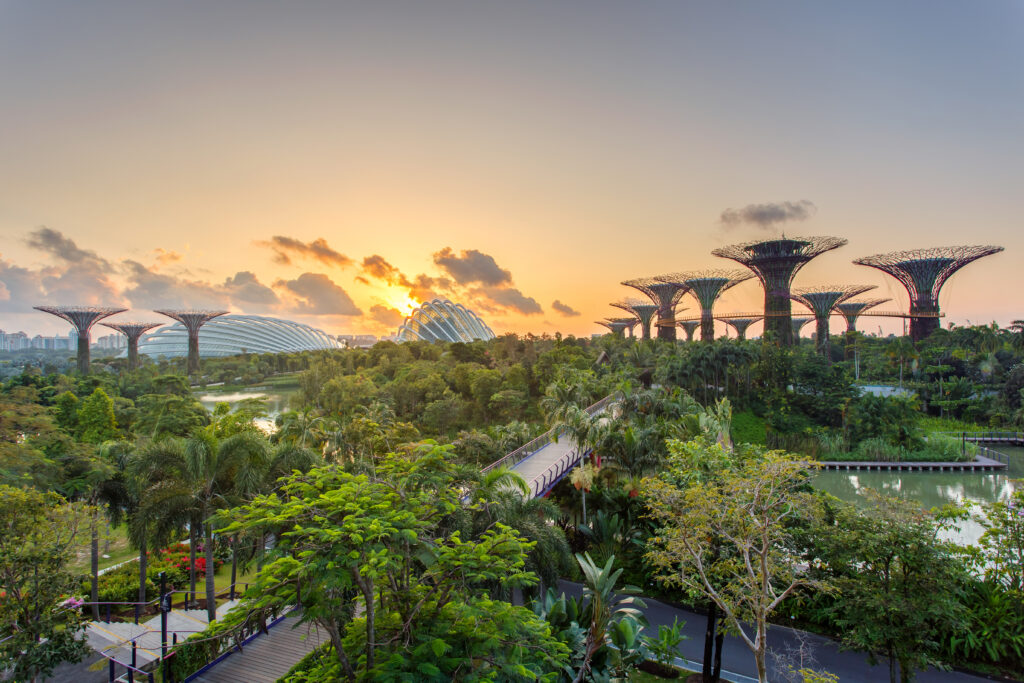
Gardens by the Bay, Singapore.
While sustainable materials are reshaping how we build, examples like Singapore show how intelligent waste management can transform entire cities. The Asian country has developed an extremely efficient waste collection and incineration system, where virtually no waste is visible on the streets. All collected waste is sent to modern incinerators, which transform the waste into ash and electricity. The ash is deposited on an artificial island, reducing pressure on conventional landfills.
In addition to ensuring a clean city, the process contributes significantly to Singapore's energy matrix. The generated smoke passes through rigorous filtration systems, minimizing environmental risks. However, this strategy is not without challenges: incinerators have a limited lifespan and can release toxic substances if not operated correctly. Even so, the model is an example of how it is possible to integrate waste management and energy generation in a sustainable urban approach.
A new way of inhabiting the planet
The convergence of innovative materials and smart urban systems shows that sustainability is no longer a trend, but a reality under construction. From greener homes to cities that reinvent themselves, the future is being shaped by choices that place the environment at the center of decisions. And, along this path, every advance—however small it may seem—is an essential piece in transforming the world into a more balanced, healthy, and habitable place for all.
Brazilian roads accumulate functions that their original design did not foresee. Redistributing the road section and taking care of the pedestrian scale…
It is crucial to remember that the concept of "environment" extends beyond the physical-natural dimension to encompass the social world. The strategies…