Tactical Urbanism: Agile Interventions as a Tool for Urban Transformation
June 28, 2023
By Matheus Coelho
CasesTendenciesUrban planning
Low-cost and rapidly implemented solutions as strategic tools for the requalification of public spaces.
In an urban context, the term "tactical" refers to the use of specific, planned, and executed actions focused on concrete transformation objectives. This is the guiding principle of tactical urbanism, a strategic approach geared towards temporary, economical, and rapidly applicable interventions aimed at requalifying public space and experimenting with innovative urban solutions.
Widely disseminated in recent decades, tactical urbanism is also known by terms such as "do-it-yourself urbanism" or "urban acupuncture," and has been used as a powerful tool to test urban projects on a small scale before their final consolidation.
Essence and Objectives of Tactical Urbanism
The essence of tactical urbanism lies in its ability to promote specific, reversible, and low-cost changes that generate a direct impact on citizens' urban experience. These interventions serve as a living laboratory to assess the feasibility of urban space reconfigurations, based on the real interaction of the population with the modified environment.
The objectives are varied, but they focus on:
Reorganization of road space, with a more equitable redistribution between modes of transport and pedestrians;
Enhancing the value of underutilized public areas, often rendered invisible by traditional planning;
Improving road safety, especially for pedestrians and cyclists;
Promoting urban community living through the creation of spaces for lingering and leisure.
Each project is designed based on the specific needs of the area. In certain areas, for example, widening sidewalks may be the priority, while in others, attention is focused on safety at critical intersections.
Tools and Elements of Intervention
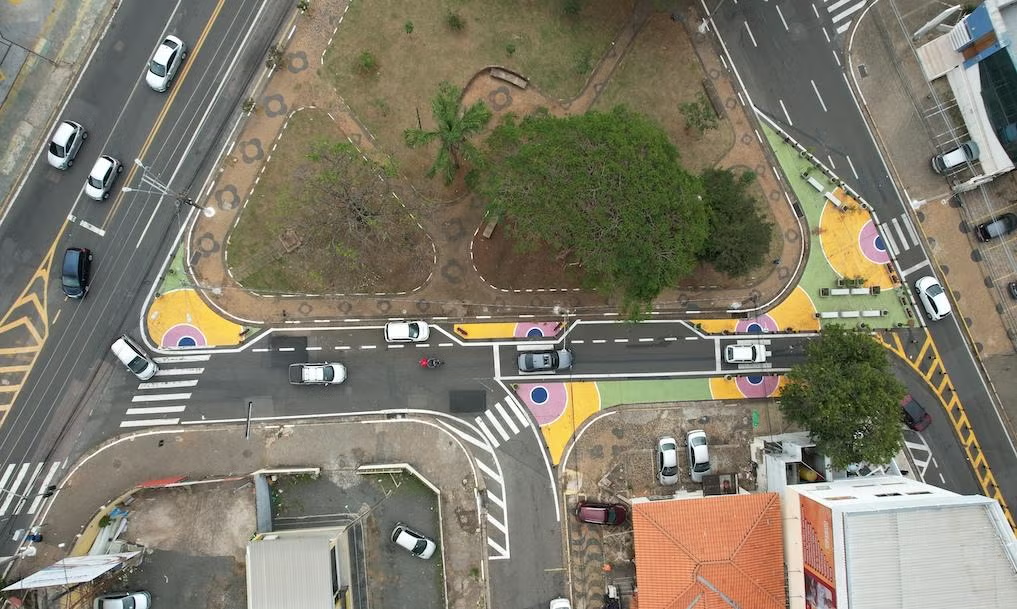
Tactical interventions utilize simple and easy-to-install materials, such as colored road paint, flower boxes, temporary street furniture, cones, road studs, and temporary signage. Among the most common examples are:
Parklets (temporary sidewalk extensions with space for rest or recreation);
Mini-plazas in former parking areas;
Safe waiting areas for pedestrians at intersections;
Redesigning the road layout using paint to induce new mobility behaviors and routines.
More than altering physical infrastructure, tactical urbanism aims to redefine urban space and stimulate collective reflection on its use. Frequently, these projects trigger new forms of coexistence, promote the shared use of streets, and encourage the population to rethink their habits of movement and where they stay.
Experiences in Brazil: Cases from Fortaleza and São Paulo
Brazilian experiences with tactical urbanism have gained consistency since the mid-2010s. In 2017, two emblematic initiatives demonstrated the potential of the methodology:
In Fortaleza (CE), the Cidade 2000 neighborhood underwent road requalification interventions focused on active mobility, promoting greater safety and comfort for pedestrians;
In São Paulo (SP), the Santana neighborhood, in the North Zone, was the setting for a pilot project that redesigned underutilized road spaces, transforming them into areas for community interaction.
These interventions demonstrated that temporary solutions can generate concrete and measurable results, and in many cases, were later converted into permanent interventions.
Transformative Potential and Scaling Challenges
Tactical urbanism represents an innovative approach within urban public policies, as it allows for rapid experimentation and direct community engagement. Its effectiveness, however, depends on consistent technical planning, monitoring of impacts, and the institutional capacity for subsequent transformation into structural actions.
Among the main challenges, the following stand out:
The need for intersectoral coordination between public bodies, civil society, and the private sector;
The importance of clear technical criteria for evaluating results, such as road safety, use of space, and public perception;
Care must be taken not to replace structural policies with palliative solutions, ensuring that tactical measures serve as a preliminary step in broader projects.
Conclusion
By democratizing urban planning, bringing the population closer to the decision-making process, and promoting concrete solutions in the short term, tactical urbanism is consolidating itself as a strategic instrument for urban transformation. Its effectiveness lies precisely in its ability to articulate technical vision, social engagement, and agile action—fundamental attributes for responding to the complex dynamics of contemporary cities.
With the advancement of experiences and the consolidation of best practices, tactical urbanism tends to establish itself as one of the most promising tools for redesigning Brazilian urban space – making cities more humane, safe, and vibrant.
Brazilian roads accumulate functions that their original design did not foresee. Redistributing the road section and taking care of the pedestrian scale…
It is crucial to remember that the concept of "environment" extends beyond the physical-natural dimension to encompass the social world. The strategies…