Implementation of Phytoremediation Systems for Wastewater Treatment in Urban Areas
The rapid growth and densification of Brazilian cities are placing unprecedented pressure on basic sanitation systems…

It is crucial to remember that the concept of "environment" extends beyond the physical-natural dimension to encompass the social world. Sustainable strategies have evolved from a paradigm centered on ecology to recognize the interrelation of so-called nature with the social, cultural, and economic dynamics that characterize human societies. In this context, in Brazil, the National Environmental Education Policy It considers the "humanistic, holistic, democratic and participatory approach" as one of the basic principles of Environmental Education, but institutional efforts to strengthen these ties in practice still seem scarce.
Organizational and regulatory arrangements, whether public or private, seem to ignore opportunities to incorporate some layer of complexity into environmental practice, settling for approaches to conservation and management of environmental resources that are extensively practiced. For example, the treatment of waste management rarely moves beyond a trivial display of the colors of selective collection, or the physical knowledge of collection containers, when it could strive to didactically introduce aspects of the urban waste production chain, rampant consumerism, shared responsibility for waste generation, or the structural problems of a legal, land, and economic nature in the management of solid waste in cities. Meanwhile, work on water resources seems to be limited to a conservationist perspective, abandoning a use that, throughout human history, has coexisted with people's prosperity, occupying an easily recognizable place in daily life.
Therefore, at times, it is worth reflecting on whether the very idealization of environmental actions has taken the transformative potential of Environmental Education seriously enough. If the purpose of the action is limited to a transmission of concepts decontextualized from a political engine and community empowerment, this will certainly hinder a positive return in terms of participation and impact.
It is evident that consistent practice requires challenging teaching and training resources. In everyday application, this also means a repertoire capable of presenting content and methodologies sensitive to broad age, socioeconomic, and cultural ranges, sometimes concentrated in the same undertaking. At the same time, collections of environmental activities for children are much more accessible and systematized compared to those for adults, an audience that, in comparison, shows significantly more costly and highly variable engagement and retention according to income, values, beliefs, among other factors.Tal; Peleg-Mizrachi, 2019There is a lack of effective and engaging methodologies and themes for adults, capable of fostering an approach with the seriousness and commitment that these topics deserve.
Institutional stagnation in Brazil regarding innovative environmental approaches remains notable, even when confronted with increasingly computer-savvy generations exposed to an unprecedented volume of content. Beyond the school setting, the proposal for Environmental Education, mobilized by public and private organizations, to incorporate humanistic and transformative perspectives on ecology, for both children and adults, remains synonymous with innovation. In this spirit, Ecominas sought to share two environmental campaign experiences in our newsletter, contributing to the creation of a body of knowledge and encouraging more challenging and comprehensive environmental education practices in favor of the environment – that is, inextricably linked to people and nature.
Today, we understand the importance of imbuing environmental campaigns with the following purposes:
Both activities detailed here are contextualized within the implementation of Environmental Education Program from the same partner venture.
The first was aimed at the internal audience of the project, that is, employees and collaborators, and the other, at the external audience, encompassing the existing neighborhood, more specifically, the users of an institutional facility that was in operation prior to the construction of this residential development in Nova Lima/MG.
The Ecological Footprint is an interesting and broad thematic alternative for environmental campaigns targeting an adult audience. This is because the concept essentially translates to an environmental indicator based on daily life, providing a foundation for new debates and reflections based on its metrics and results. In this case, the target audience consisted of a segment of the earthmoving construction team, gathered in the cafeteria after their lunch break.
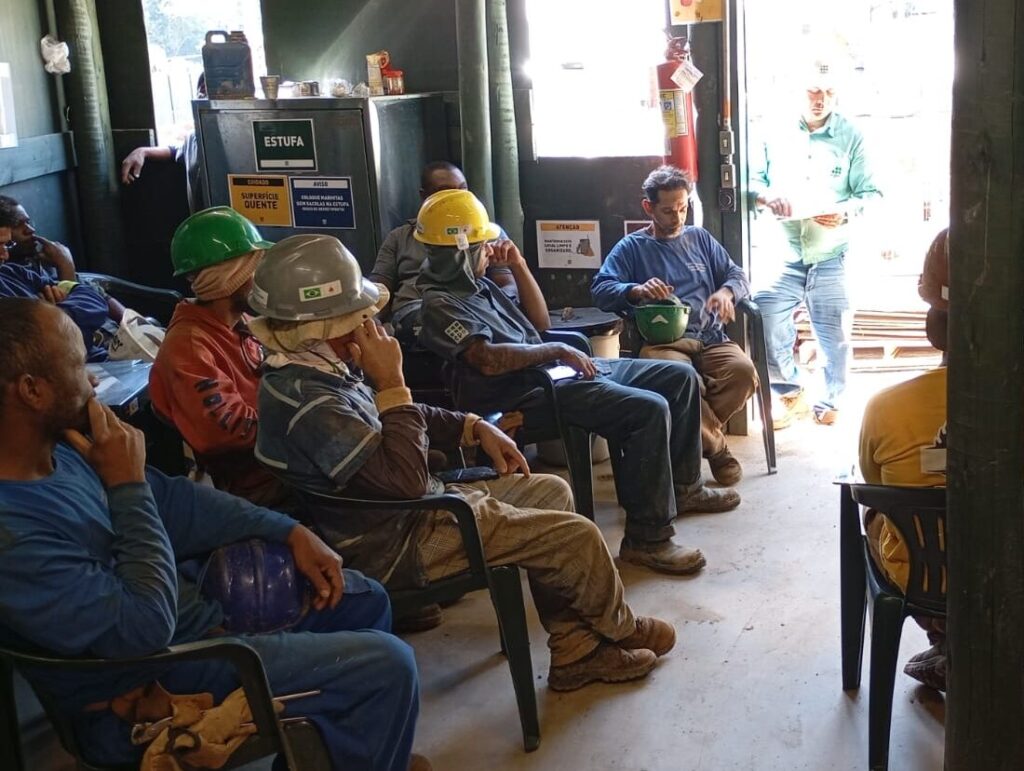
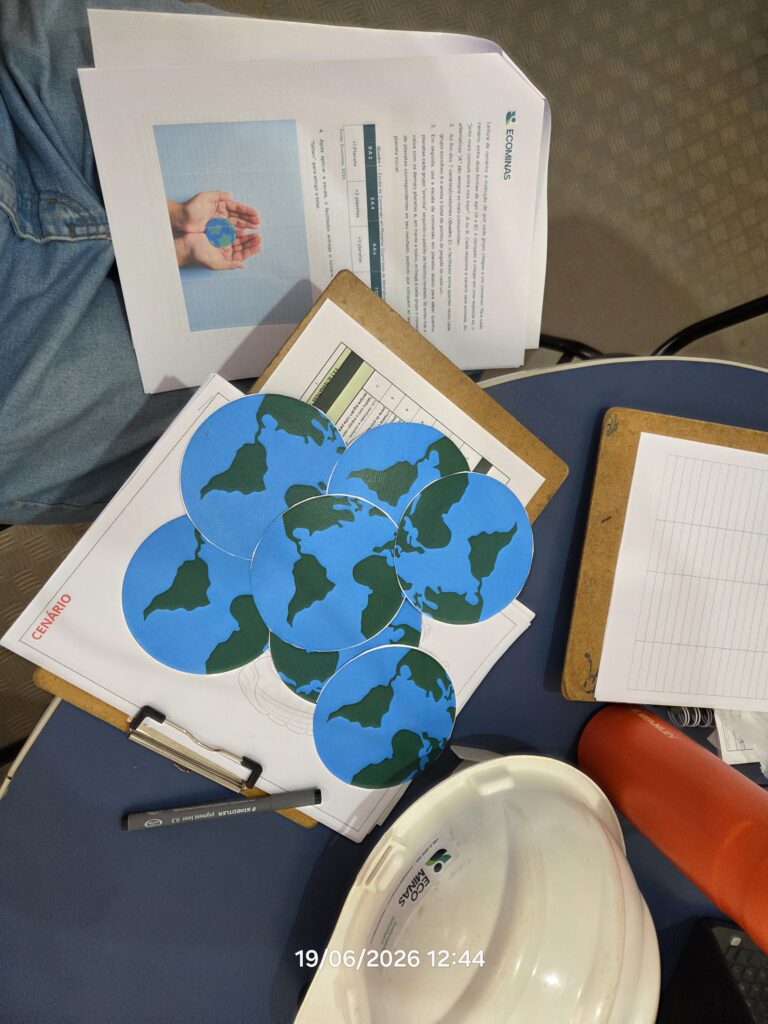
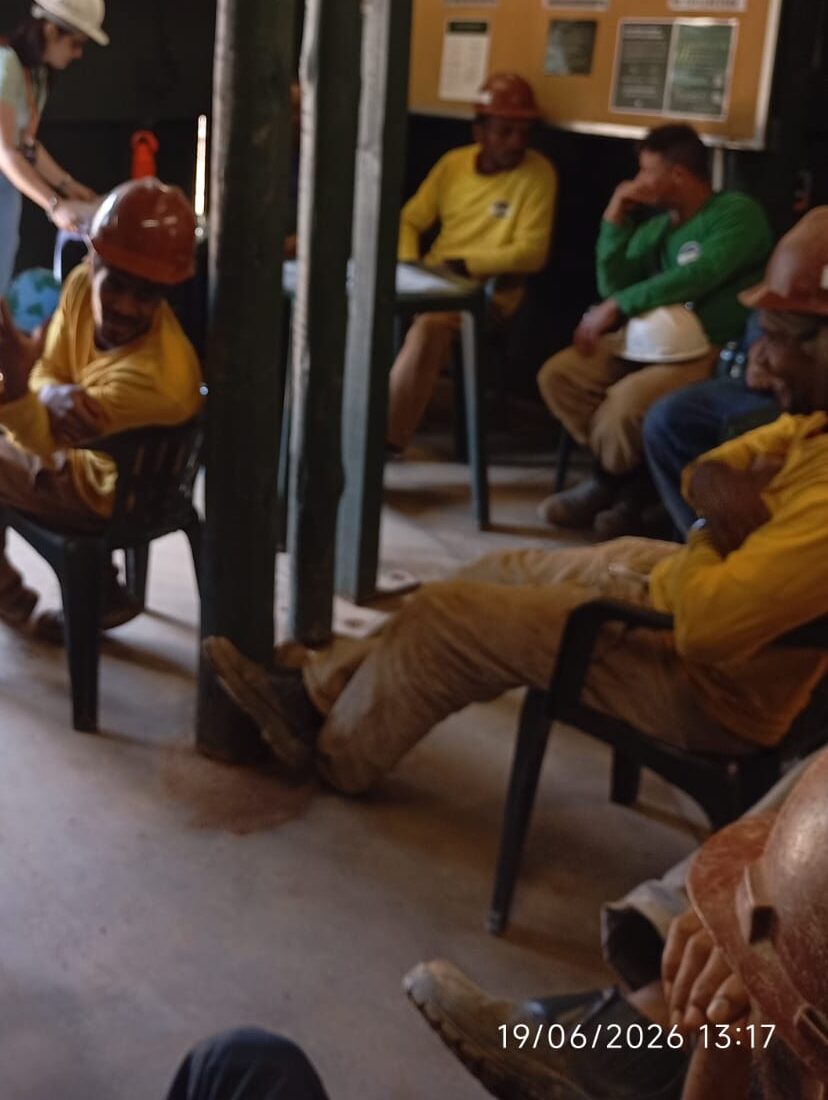
In the activity implemented by Ecominas, after a brief introduction about human needs and the consumption of natural resources on Planet Earth, participants were divided into three large groups. Each group then received a small Earth cutout from 180g cardstock, approximately 15cm in diameter. Next, it was explained that seven real-life situations would be read aloud, covering consumption of goods, food, organization of materials, reuse of leftovers, use of disposable items, electricity, and water, and that each group should, by consensus, indicate which alternative most closely resembled their current habits. It was emphasized that the answers should reflect routines, not what they knew to be ideal for each situation – and that it was not a matter of choosing "right" or "wrong." For example, one of the alternatives was:
| SITUATION | LETTER A | LETTER B |
| Light, fan and comfort – In the changing room or accommodation, the light and fan are sometimes left on even when the space is empty, so that when someone enters it is already “pleasant”. Not everyone comes back to turn them off. | You don't get too involved with it: if it's on, you leave it like that, because it's more comfortable to arrive in a room that's already lit and cool, and you don't feel like it's directly your problem. | You've gotten used to taking a look around when you leave; if you see a light or fan on in an empty room, you turn it off, even if it seems annoying to always be the one to turn it off. |
After each reading, the groups had 1 minute and 30 seconds to reach a consensus between alternatives "A" and "B," after which the activity facilitator noted the preference on a supporting spreadsheet. At the end of the activity, after tallying the responses, a Planet Conversion Scale was used, which presented numerical correspondences between the choice of the letter "A" and the distribution of a certain number of additional small Earth-like planets (e.g., 4 choices of A were equivalent to +3 planets).
It was emphasized that the dynamic exaggerated the weight of consumerist practices and numerical correlation to planets, to fit the context of the meeting, but that it intended to convey the notion that, if the habits of all the people in the world coincided with those, we would need "X" more planet Earths. This was, then, a representation of the ecological footprint, as a scientific methodology mainly applied to individual habits, responsible for quantifying the impact we cause through our consumption habits, leading to reflection on both routine and individual and collective possibilities for more ecologically and socially sustainable realities.
It was highlighted that the ecological footprint aims to be, above all, a tool for reflection on the relative impact of daily habits and consumption patterns on natural resources. It was clarified that the activity's purpose was not to impose behaviors or make moral judgments about participants' habits, since not everything in daily life depends on choices for or against the environment. The aim of the discussion was to broaden understanding of how decision-making relates to broader environmental effects, serving not only to consider individual responsibility but also to improve skills for evaluating the weight of collective and public policies and decisions, developing critical thinking about environmental issues.
The activity sparked clear curiosity about consumption patterns and led to productive discussions that blended with relaxed conversations about everyday habits that could, or could not, be improved in favor of more environmentally conscious practices. At the same time, it was possible to touch upon the scale of institutional and political responsibility for environmental choices, leading to the notion of multilevel decision-making that transforms the ecological-environmental reality in which we are collectively embedded, according to our particularities, including the highly variable availability of natural resources and even more sustainable consumption alternatives, according to income, geographic and social insertion.
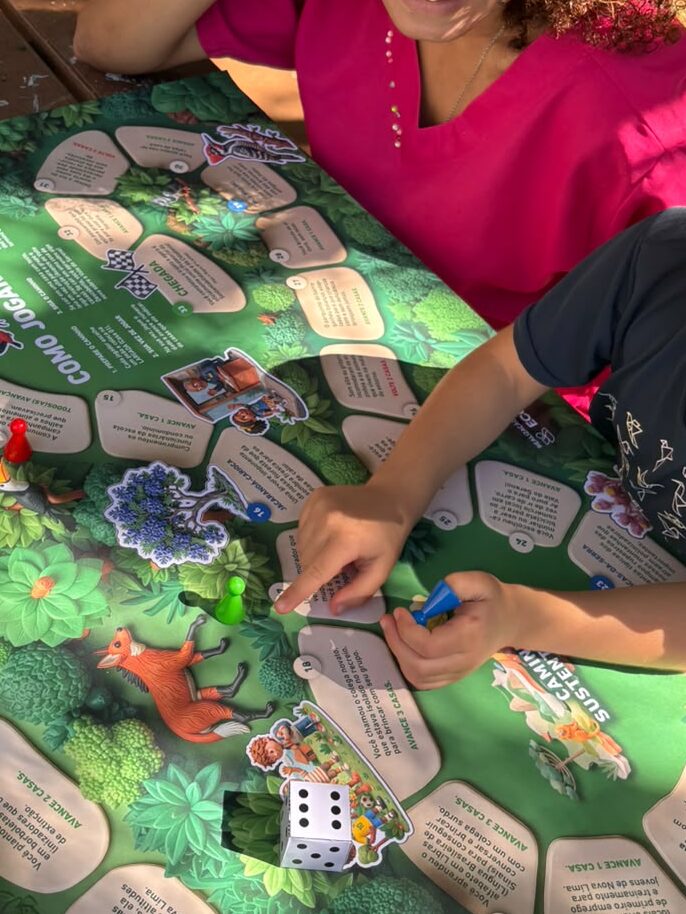
Inspired by initiative From the Petrobras Group, Ecominas developed a board game, in A3 size, about sustainability practices involving behaviors for the preservation and conservation of local ecosystems, at home and in collective spaces, and civic attitudes in the neighborhood and city, aimed at children from three years of age.
The game board, titled "Paths to Sustainability," features 33 spaces, alternating between messages about ecology, citizenship, community living, and discoveries about the local flora and fauna. The material forms a kit along with a die and 4 assembleable game pieces, the mold for which complements the set of deliverables.
Based on the result of the die roll, the player advances or retreats according to whether they are more or less careful with nature and the community, that is, with the environment, such as planting flowers that attract pollinators, separating recyclable waste, or helping a classmate with a physical disability find an accessible path, welcoming a new classmate to school, etc., associated with movements of advancing spaces as a symbolic reward. On the other hand, some spaces represent actions such as trampling native plants, leaving lights on unnecessarily, or generating noises that disturb neighbors and wildlife, indicating movements of retreat or loss of a turn, reinforcing the practical consequences of the choices. The Finish line confers the title of "Solidary Leader," with an additional cooperative rule that encourages pulling pawns from teammates who have fallen behind, until everyone reaches the end of the course.
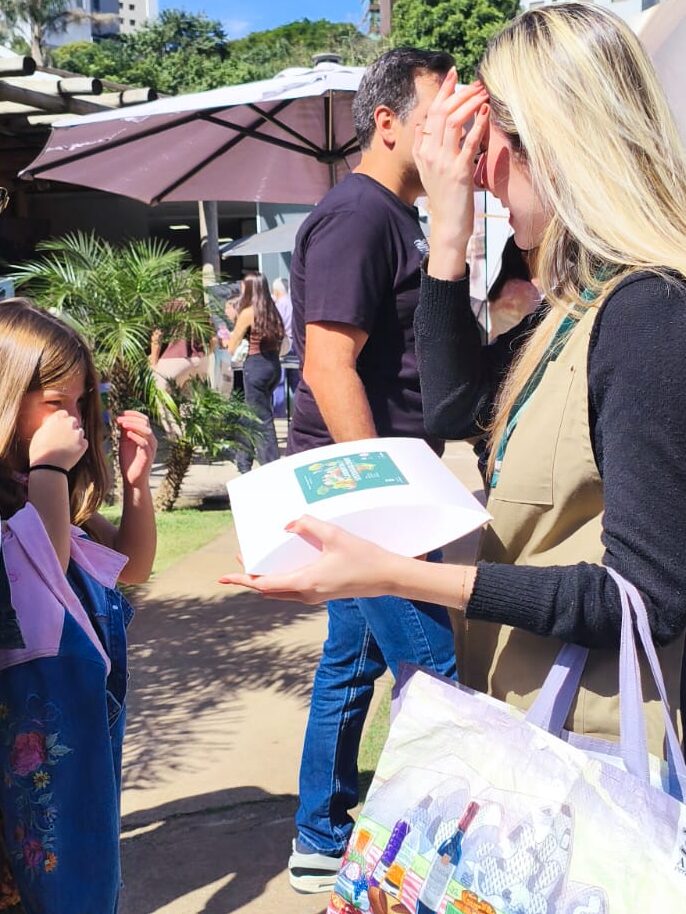
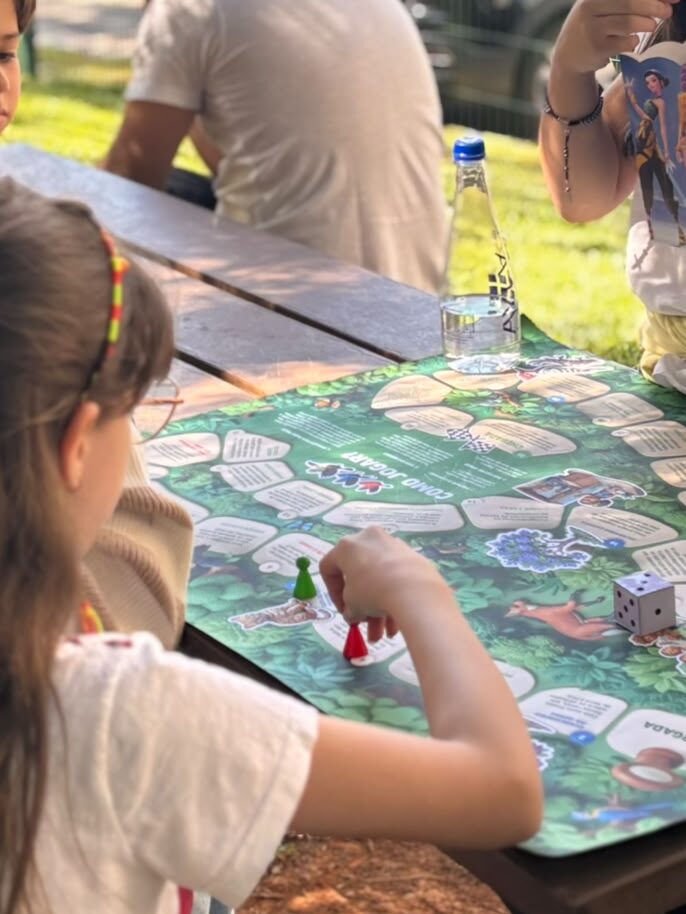
The participating children were approached after leaving Sunday mass, along with their parents or guardians, who were invited to participate in a simulation of the activity, or could choose to receive a kit, the distribution of which was part of the environmental action for the implementation of the Environmental Education Program (PEA). The action garnered collaboration and attentive interaction from both children and adults, contributing to strengthening the relationship between the project and the surrounding community, promoting environmental education as an instrument of social participation, valuing the territory, and encouraging the adoption of practices aimed at environmental conservation and improving the quality of life locally.
You can find out more about this environmental campaign at [link]. Instagram from Ecominas!